Independent Product / Commerce Case · DatVietVAC Merchandise Manager lens · Working V2
Public evidence, one direct black-box shopping session, a user-supplied qualitative signal, and working hypotheses. This case does not claim access to DatVietVAC internal analytics, contracts, margins, source code, customer data, rights, or technology architecture.
#Case at a glance
I began with one ordinary shopping session on VieSHOP. The store was usable enough to complete, but the journey exposed friction before any larger fandom feature became relevant: slow page and cart interactions, a campaign CTA that returned a 404, campaign-led navigation, product pages that made choice harder, awkward unavailable variants, and little visible post-purchase utility. These are scoped observations from one session, not a full performance audit.
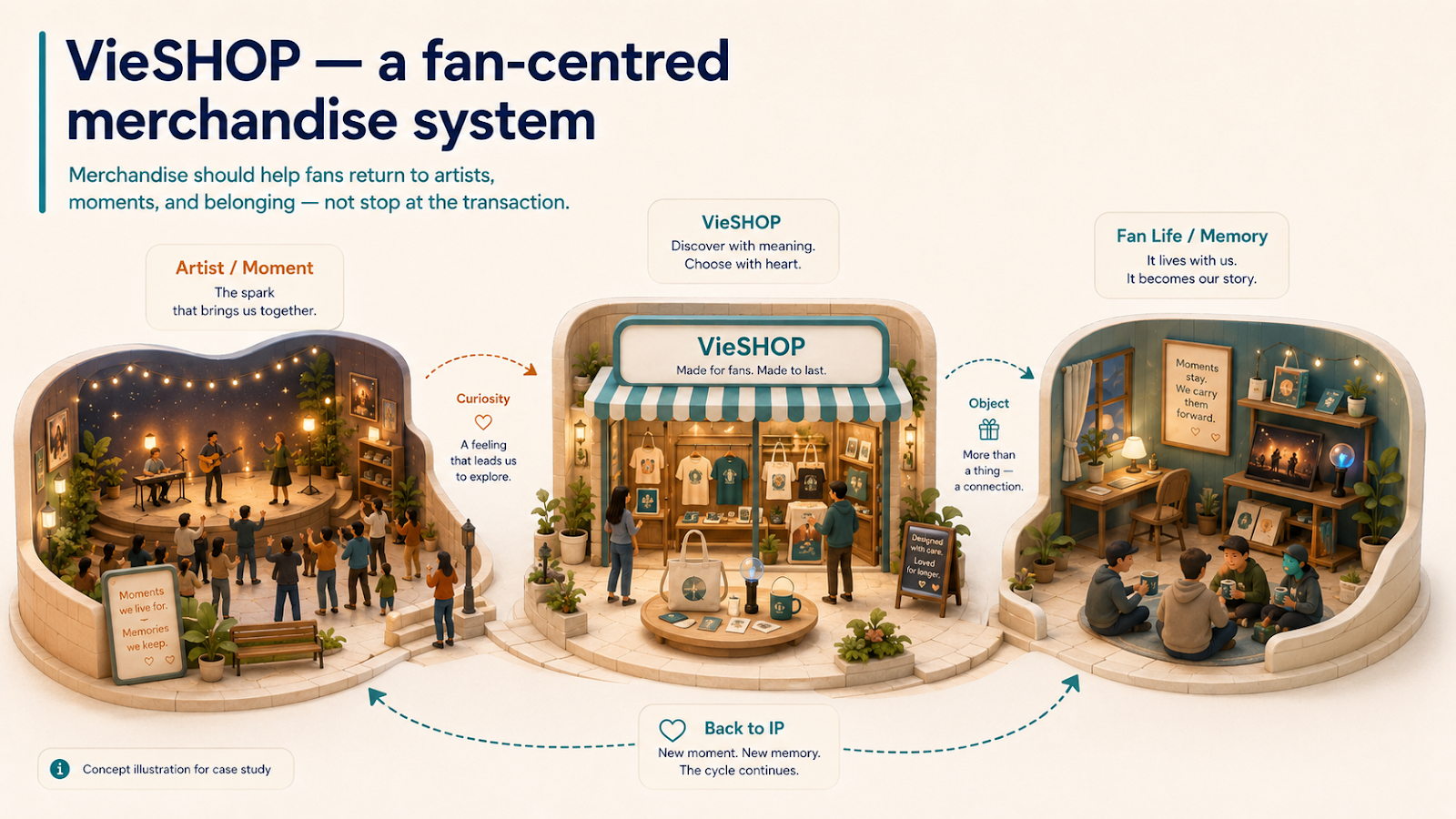
The case asks what VieSHOP would need to become if merchandise has to serve more artists, IPs, product roles, and a longer fan relationship. The working answer is a fan-centred merchandise system with two connected tracks: repair the commerce foundation first, then build a merchandise learning loop across artist discovery, product roles, assortment, rights, vendors, quantity, launch, and transfer to a second artist.
#What changes first
The recommendation is deliberately practical:
- Measure and stabilise the critical store path. Fix broken CTAs and verify homepage, catalog, product, cart, checkout, account, order, and support tasks before adding feature weight.
- Rebuild discovery as a stable system. Let fans browse by Artist, Show / Event / IP, Product Family, Availability, and Price rather than relying on a small set of campaign-led routes.
- Make product, account, and recovery states useful. A product page must explain identity, available variants, quality, sale state, delivery or pickup, and what happens when the promise fails. My VieSHOP begins with order, claim, support, and wishlist continuity—not avatars or social features.
- Test merchandise as a learning loop. Start with a bounded portfolio across Daily / Core and selected Premium / Limited / Event roles. Learn from paid demand, quality, support burden, contribution, and whether the operating model transfers to Artist 2.
Repair the store → rebuild discovery → clarify product, account, and support → run a small merchandise pilot → learn from paid behaviour → test Artist 2 transfer → prepare future interfaces.
#Two connected workstreams
| Workstream | What it addresses | Merchandise role |
|---|---|---|
| Commerce Foundation | Performance, navigation, product clarity, cart and account continuity, order and support recovery. | Define fan and product requirements, acceptance criteria, launch risk, and commercial consequence. |
| Merchandise Growth | Artist discovery, product roles, assortment, rights, vendor, price, quantity, inventory, and launch learning. | Own the commercial decision path and the repeat / redesign / stop recommendation. |
Product and Tech own architecture and implementation. Merchandise needs the control view: which gate is blocked, who owns the next decision, what evidence is missing, and what recovery option remains when the promise to the fan is at risk.
#Operating sequence & controls
The work should advance through six bounded stages: reality check, critical-path stabilisation, discovery MVP, a small product pilot, launch-and-learn, and Artist 2 transfer. Each gate needs a visible owner, the evidence required to proceed, the consequence of delay or failure, and a recovery path.
Campaign links also need lifecycle ownership. A lightweight register should record the URL, owner, live dates, intended state, fallback or redirect, and last validation. This turns a broken CTA from a one-off web defect into a preventable control failure.
Company control does not require self-hosting every layer. It requires the ability to observe the state, make the decision, and recover the fan promise when a vendor or platform handoff fails.
#Measurement & reversal
The minimum view combines store usability, discovery quality, paid demand, product-role performance, support burden, inventory and contribution, and whether the operating model transfers beyond the first artist.
The pilot should pause, narrow, or reverse when the critical path remains unstable, rights or vendor readiness cannot be confirmed, unavailable states cannot be handled clearly, support cost overwhelms the product role, or Artist 2 cannot reproduce the result without exceptional effort.
#What remains conditional
Vie World and other future layers
Vie World is a proposed future relationship layer, not a dependency of the recommendation and not a confirmed DatVietVAC roadmap. VieSHOP may eventually sit inside it as a commerce module or beside it as a connected service. The store and merchandise model must still work if the concept changes or never launches.
Membership benefits, digital merchandise, SKU-level pricing, and control-transfer choices also remain conditional. They require internal evidence on rights, COGS, contribution, inventory, target buyer behaviour, technical constraints, operating ownership, and support burden.