Independent outside-in case · Platform Operations · Reader Edition
Two connected research cuts. Part I establishes the trust-chain integration problem. Part II updates the diagnosis against MFan's public 2026 surfaces and asks whether one current membership promise can remain recognizable, deliverable, explainable, and recoverable across every party that touches it.
Evidence boundary: Public product surfaces and policies can establish what is visible and promised. They do not establish MFan's internal architecture, operating performance, incident rate, or roadmap.
#Part I — Platform Fragmentation & Trust-Chain Integration
#The original operating question
A fan relationship can cross an artist page, membership layer, campaign surface, merchandise store, ticketing partner, payment provider, logistics provider, and support channel. None of those surfaces has to be broken for the overall journey to fail. The problem begins when identity, entitlement, transaction state, fulfilment, support, and reporting stop carrying the same operating truth.
The original case therefore proposed a minimum shared layer rather than a full platform rebuild:
| Capability | Operating purpose |
|---|---|
| Fan identity | Recognize the same fan where continuity, service, entitlement, and recovery require it. |
| Entitlement record | Show which access, benefit, item, or status exists and whether it is active, used, disputed, corrected, or expired. |
| Payment and order reconciliation | Keep payment, order, entitlement, fulfilment, and refund states distinguishable but reconcilable. |
| Ticket and event access | Connect identity, eligibility, ticket state, use, and onsite recovery authority. |
| Support and fulfilment context | Let an owner act without asking the fan to reconstruct evidence already held elsewhere. |
| Artist and campaign reporting | Return delivery, settlement, incident, and recovery outcomes to one operating picture. |
The durable insight from Part I is not that every surface must use one tool. It is that shared state, ownership, evidence, and recovery must survive wherever separate tools and partners contribute to one promise.
Part I takeaway: A creator platform becomes more than a collection of campaigns when identity, entitlement, payment, fulfilment, support, and reporting remain connected through both success and failure.
#Part II — When an Integrated Platform Still Needs an Operating Model
#What changed
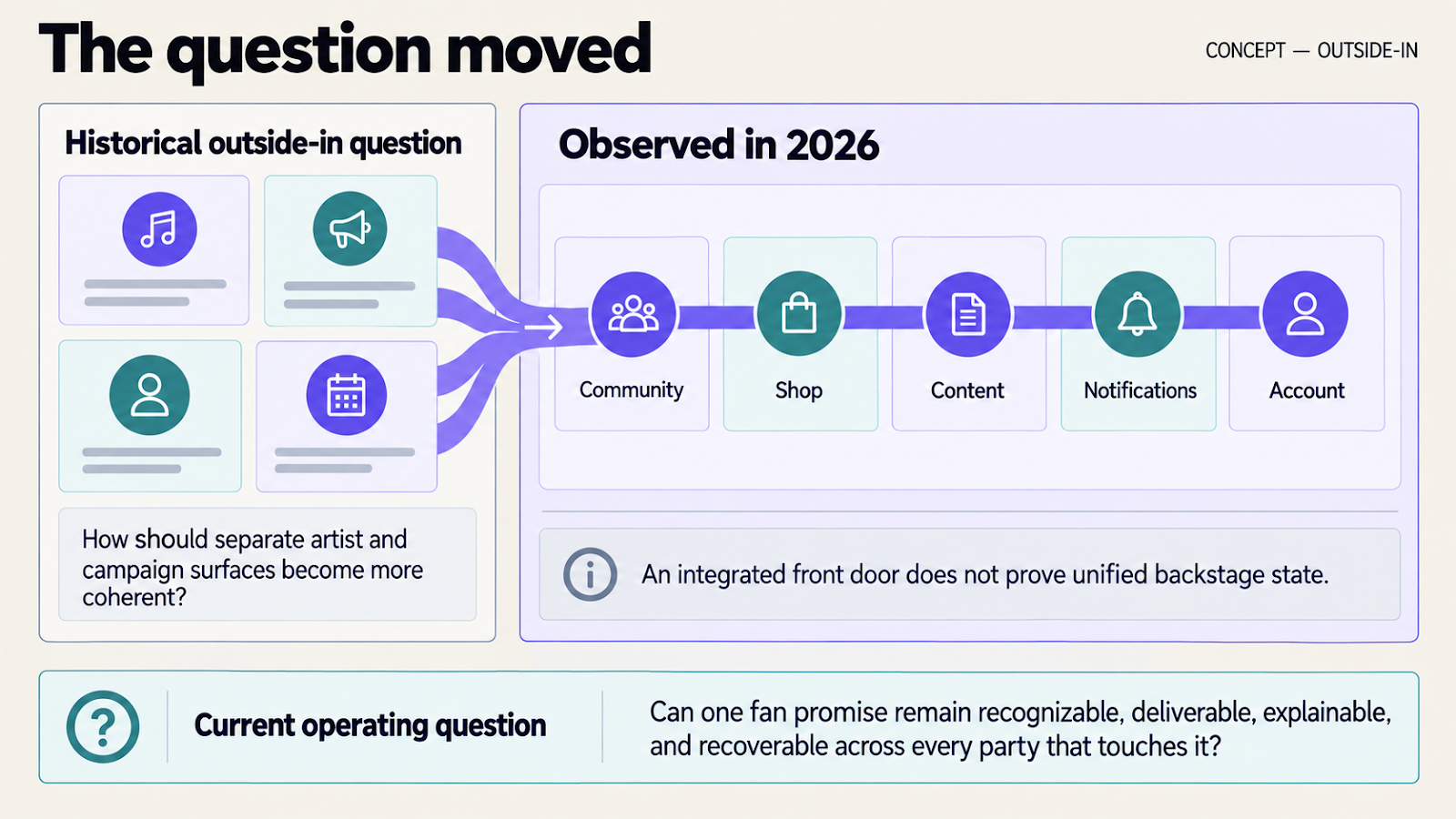
The historical outside-in question asked how separate artist and campaign surfaces should become more coherent. The current public MFan experience presents a more integrated front door: community, shop, content, notifications, account, artist, event, membership, and merchandise surfaces are more visibly connected.
That changes the research question. It does not prove that backstage state is unified, and it is not evidence of a failed migration or current operating breakdown. The sharper question is now:
Can one fan promise remain recognizable, deliverable, explainable, and recoverable from purchase through activation, benefit use, exception recovery, and reporting close?
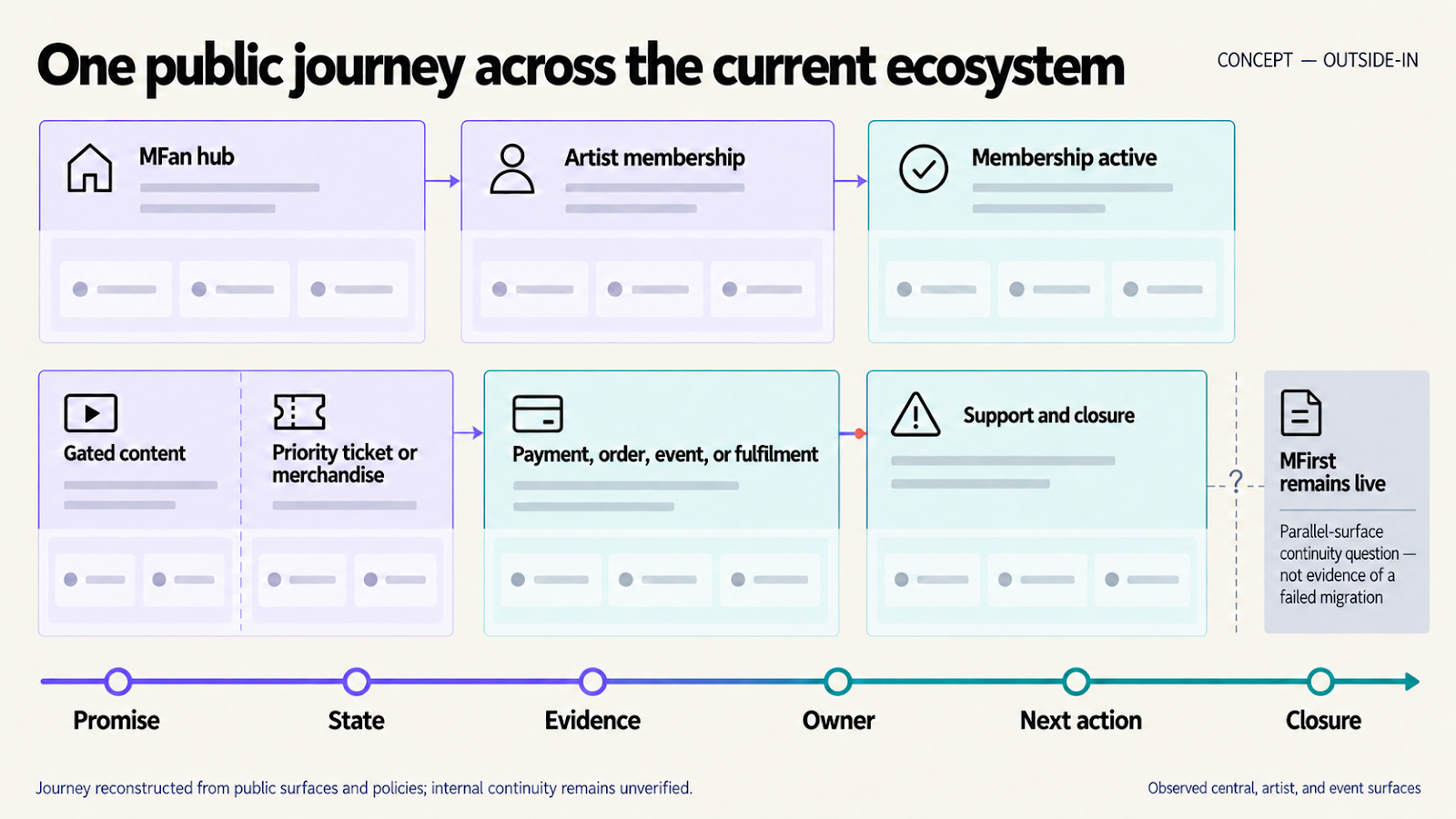
#One public journey, one continuity test
A fan may enter the MFan hub, join an artist membership, receive an active status, use gated content, pursue a priority ticket or merchandise benefit, complete payment or fulfilment, and contact support. The journey is coherent only if the promise, state, evidence, accepted owner, next action, and closure remain intelligible across those moments.
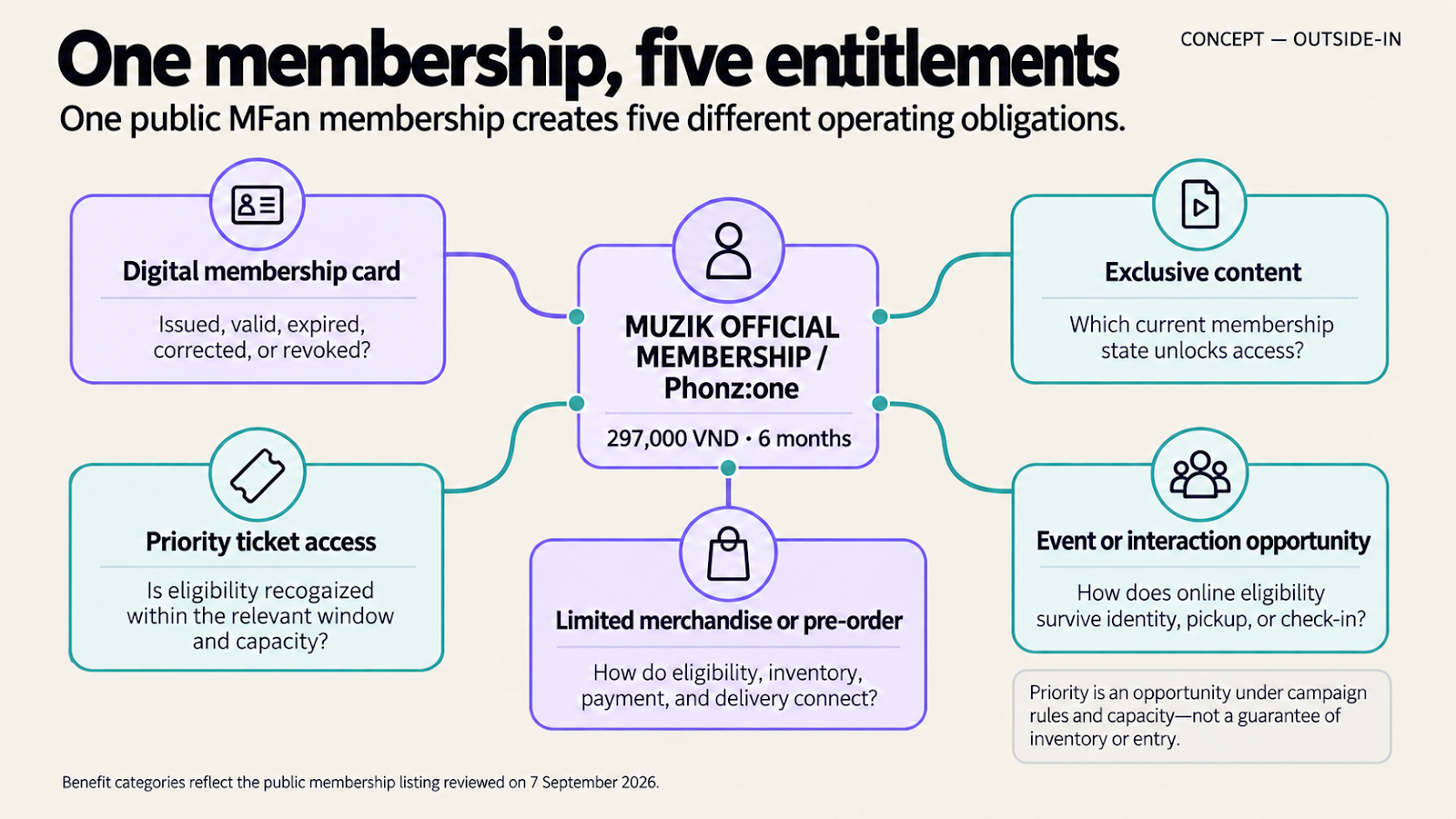
#One purchase creates several operating obligations
A membership purchase is not a single completed state. It can create a digital membership card, gated-content access, priority ticket access, limited merchandise or pre-order eligibility, and an event or interaction opportunity. Each benefit has its own rules, validity window, capacity, fulfilment path, and recovery boundary.
#The state that must survive
The operating model should preserve related states without collapsing them:
- payment authorized is not the same as payment settled;
- payment successful is not the same as order created;
- order created is not the same as membership activated;
- membership active is not the same as a priority benefit being available;
- ticket issued is not the same as checked in;
- carrier pickup is not the same as delivered;
- support replied is not the same as the fan recovered;
- refund requested is not the same as refund completed.
The minimum continuity model has six records or capabilities:
- Promise record. What was offered, under which version, terms, dates, capacity, and partner conditions.
- Eligibility and entitlement record. Who qualifies, what right exists, its validity, use, correction, expiry, or revocation state.
- Transaction and execution state. Payment, order, ticket, access, fulfilment, delivery, refund, and settlement remain distinct but reconcilable.
- Accepted handoff. The current owner remains accountable until the receiving owner confirms authority, context, and next action.
- Recovery case. One case preserves the original promise, relevant evidence, mismatch, owner, next update, correction, and fan-visible outcome.
- Closure and learning record. A case closes only when the fan outcome is communicated, domain actions are complete or bounded, relevant records agree, and recurring causes can be reviewed.
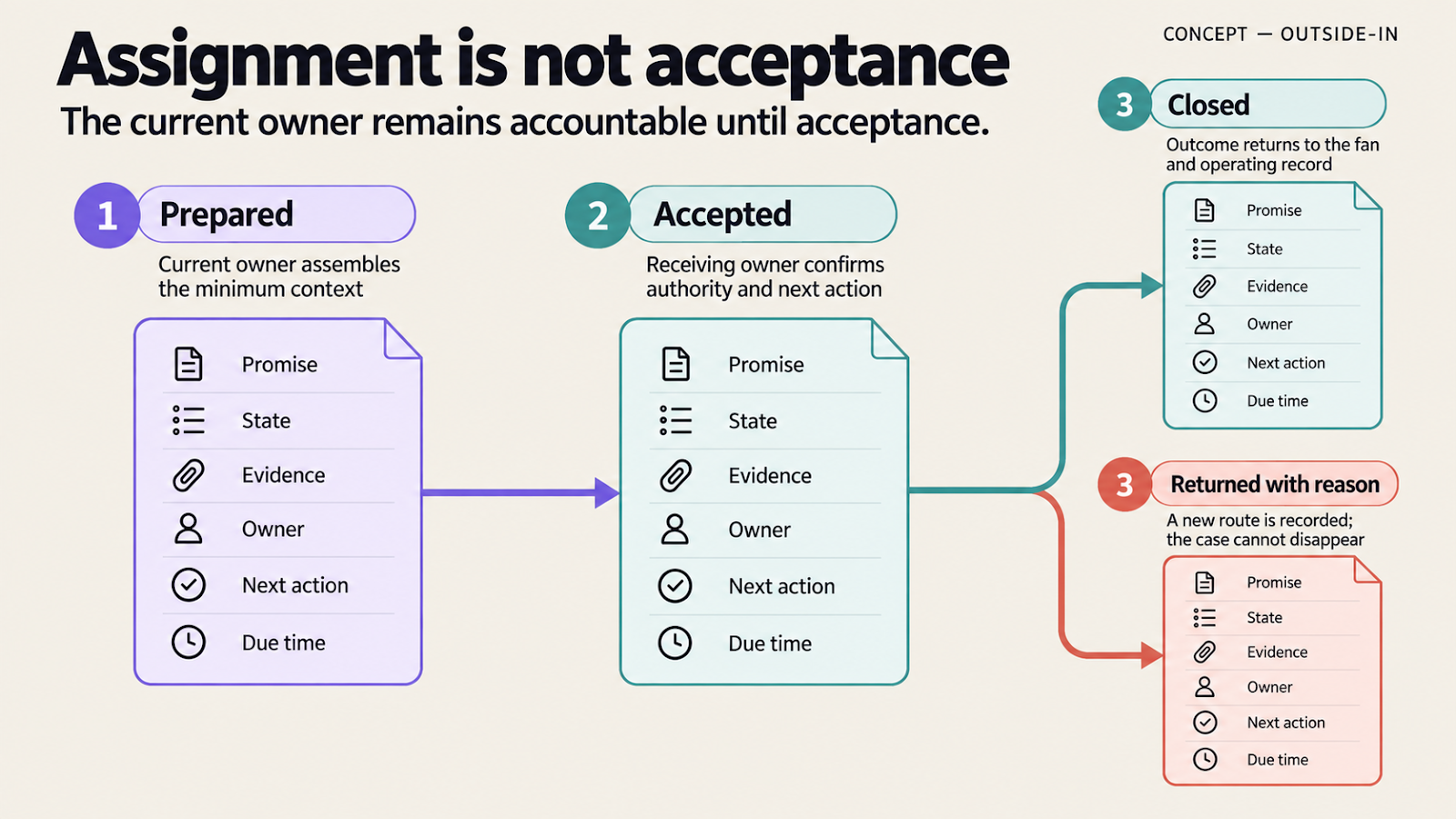
#Assignment is not acceptance
Sending a case to another queue does not transfer accountability. A valid handoff requires the current owner to prepare minimum context, the receiving owner to acknowledge the issue and accept the next action, and any rejection to return with a reason and a new route. Until acceptance, the current owner remains responsible for the next fan update.
#A bounded exception scenario
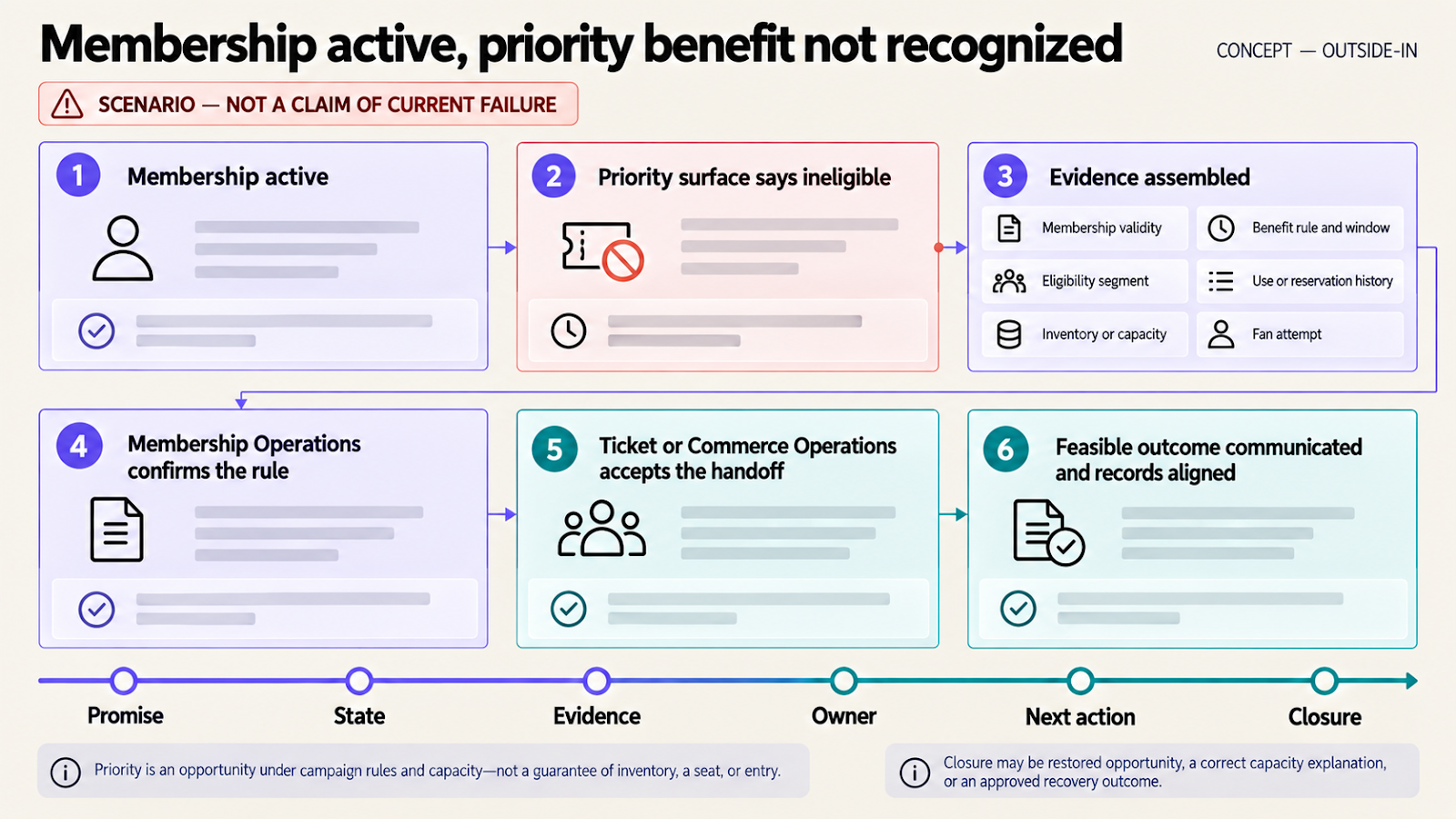
Consider an active member whose priority benefit is not recognized. This is a scenario for testing the model, not a claim that MFan currently fails in this way.
The recovery path should assemble membership validity, the benefit rule and window, eligibility segment, use or reservation history, inventory or capacity, and the fan's attempt. Membership Operations confirms the rule; Ticket or Commerce Operations accepts the handoff; the fan receives a feasible outcome; and the relevant records are aligned. Closure may mean restored opportunity, an accurate capacity explanation, or an approved recovery outcome—not an invented guarantee.
#Prove continuity in one journey
The first move should be a bounded pilot, not a platform-wide rebuild:
- one artist;
- one membership tier and current offer;
- one gated-content benefit;
- one priority ticket or merchandise benefit;
- one payment or order route;
- one support route;
- one reporting and settlement close.
The operator view should answer five questions without reconstruction: Who is the fan? What was promised? What is the current state and source? Who has accepted the next action? What conditions constitute closure?
The north-star is whether one current membership promise remains coherent from purchase to a valid close. Supporting measures should cover activation and entitlement recognition, payment-to-order and payment-to-entitlement matching, accepted-owner time, proof re-submission, first useful response, recovery and closure, record reconciliation, manual load, privacy, legitimate access, and partner burden. Numeric targets should follow a real baseline rather than invented MFan performance assumptions.
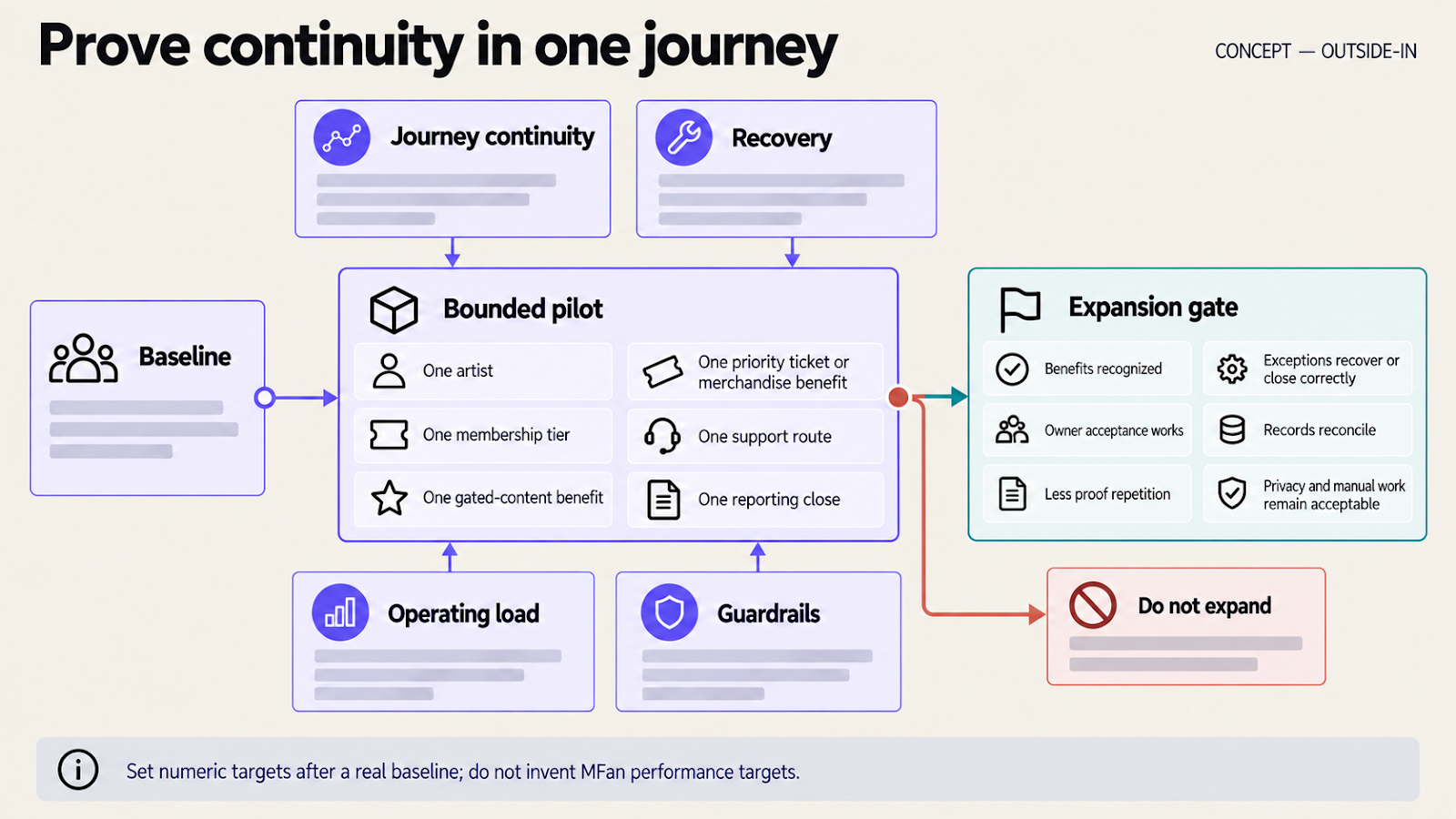
The pilot should be narrowed, redesigned, or stopped if current internal processes already solve the problem; the harm is too low to justify intervention; privacy or access risk is disproportionate; accepted handoffs slow action; the fan-facing state creates confusion; manual work exceeds recovered value; artist-specific rules defeat a shared grammar; or a simpler copy, policy, staffing, or configuration fix performs better.
#Relationship to Artist Fandom
Artist Fandom Page & Fan Dashboard remains a separate fan-facing product concept. It explores how continuity could appear in an interface. This operating model asks what must remain true behind the interface. Neither validates the other, and the cases should not be merged into one claim.
#Final takeaway
Integration is not only the presence of connected surfaces. It is the continuity of promise, state, evidence, accepted ownership, recovery, and closure across the full fan journey.
The updated case therefore keeps the original trust-chain foundation and moves the decision forward: validate one real membership pathway, measure whether continuity and recovery improve, and expand only when the evidence supports transfer to another artist or offer.
#Continue reading
Artist Fandom Page & Fan Dashboard — the fan-facing companion concept.
Post-Signing Artist / Label Operations — the partnership and execution layer after agreement.