#Making verified fan contribution persist beyond a transaction or event
Merchandise Growth & IP Commercialization Case · Developed Work Sample
Public evidence + Merchandise Manager JD · Outside-in case · August 2026 · Not commissioned by DatVietVAC

This case started from two ideas that look emotionally similar but operate very differently: recognizing past customer contribution with ownership at a corporate milestone, and preserving verified event/card history over time. I keep them separate because the first depends on securities feasibility; the second depends on identity, provenance, event operations, and merchandise economics.
#Executive Summary
- Question: Can verified fan contribution persist beyond a purchase or event as ownership, history, or recognition—without turning novelty into uncontrolled cost or operational complexity?
- Idea 1 — Ownership: test whether verified high-value historical customers could be recognized through an opt-in ownership mechanism after listing, subject to securities feasibility, approved transfer structure, budget, identity quality, and Legal/IR review.
- Idea 2 — Event Joining Card / History: bind eligible event-linked physical cards to a verified fan account, preserve the exact digital collection history, separate verified attendance from card ownership, and test optional milestone returns and rewards.
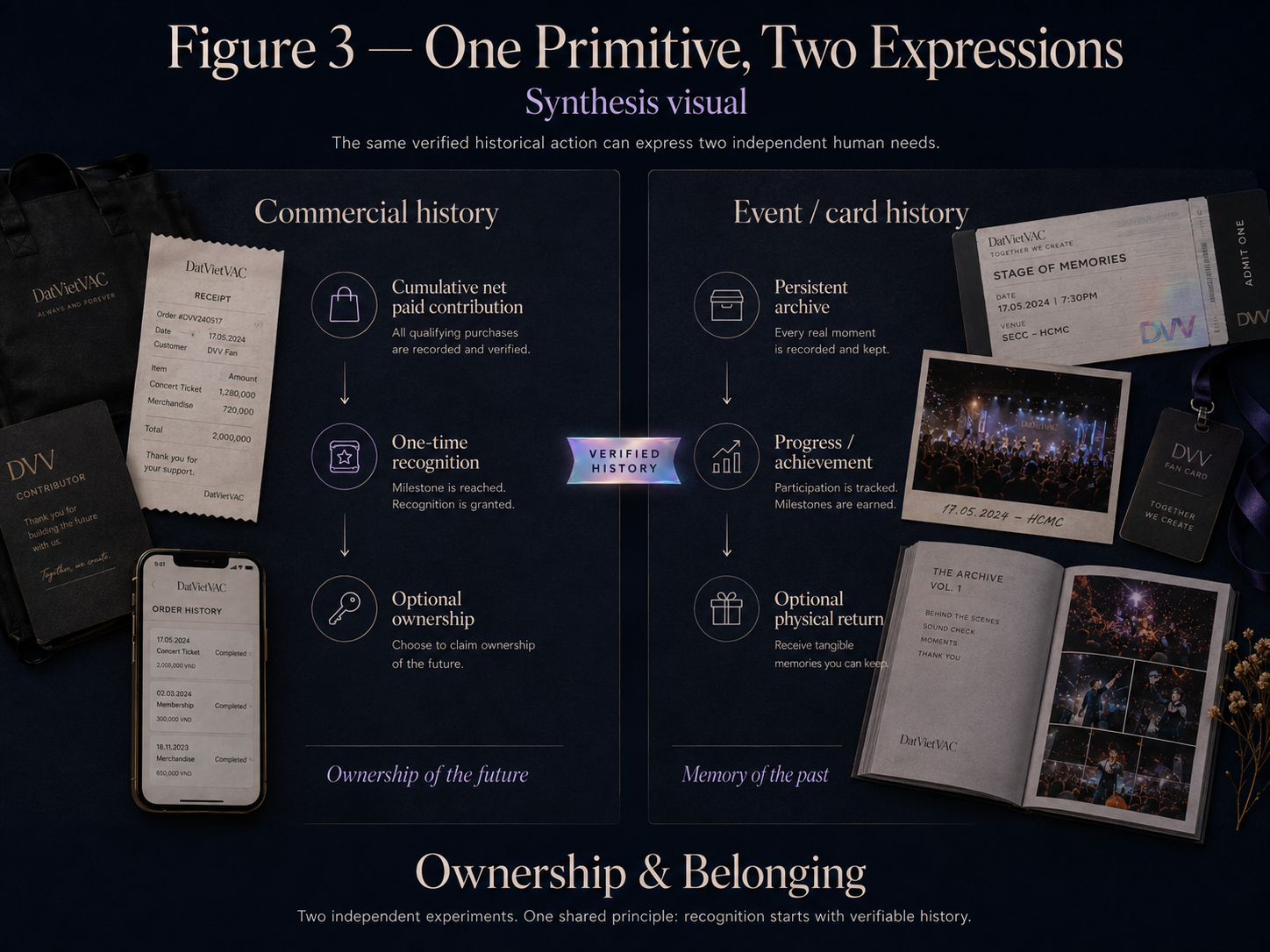
- Shared primitive: User ID + verified historical action. One idea uses cumulative paid history; the other uses event/card history.
- Decision logic: treat the two ideas as separate experiments. Either one can fail feasibility without invalidating the other.
This page is the portfolio summary.
The full case contains global benchmarks, behavioral research, ownership models, KPI trees, cost scenarios, risk controls, roadmaps, measurement design, and source links.
#1. Why Now
The public case context combines three signals: DatVietVAC’s transition toward a listed-company era, a stated 2026–2030 emphasis on multi-layer IP monetization and the fandom economy, and a Merchandise Manager scope that spans product portfolio, pricing, B2B/B2C growth, event commercialization, suppliers, inventory, P&L, and cross-functional coordination.
The portfolio question is therefore not simply how to create two promotions. It is how verified customer history could become a durable commercial asset while keeping feasibility, economics, identity, and ownership explicit.
- Evidence boundary The case uses public company/product information, comparable public programs, behavioral research, and the Merchandise Manager JD. It does not claim access to DatVietVAC’s internal identity architecture, customer distributions, contracts, economics, loyalty/CRM systems, securities-transfer mechanism, supplier capacity, or current operating ownership.
#2. Two Experiments, Not One Program
#Idea 1 — Listed-Era Ownership Concept
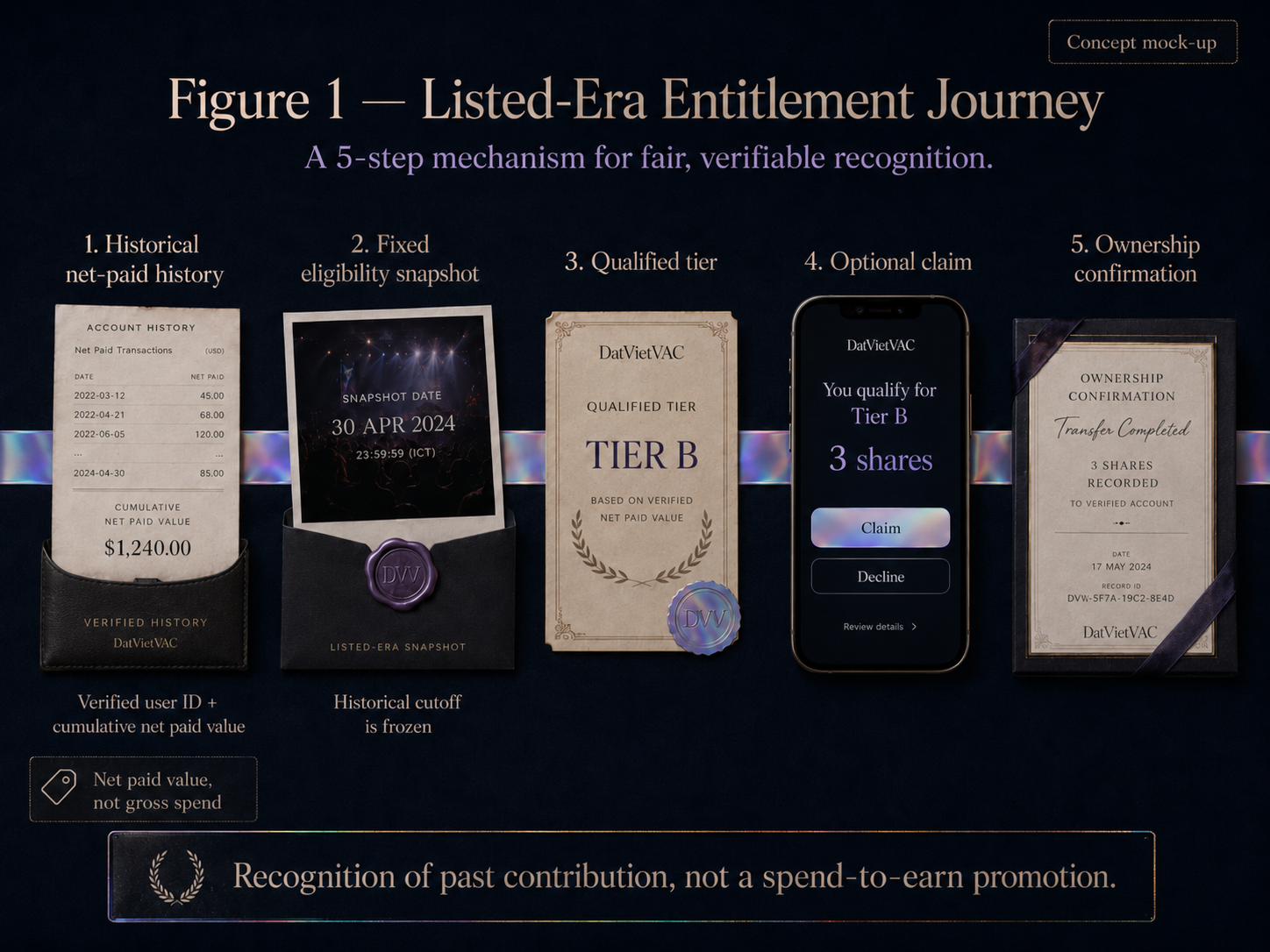
Working proposition: use a fixed historical snapshot of verified net paid value to identify eligible high-value customers, then test an optional ownership-recognition mechanism after listing.
Why the historical cutoff matters: the mechanism recognizes value already created rather than encouraging customers to spend more now to qualify.
Primary dependency: securities feasibility. Cohort logic, tier economics, identity quality, budget, claim flow, and communications matter only if an approved transfer structure is executable at the intended scale.
Merchandise role boundary: own the customer concept, cohort economics, KPI, budget scenarios, and go/no-go recommendation—not securities execution.
#Idea 2 — Event Joining Card: Fan History + Optional Physical Return
Working proposition: give each eligible physical event card a unique identity, bind it to a verified fan account, preserve the exact digital collection history, and let fans optionally return selected physical cards at milestones without deleting the memory.
Important distinction: attendance history ≠ card collection history. Verified attendance should come only from a reliable ticket/check-in/order source; owning a transferable card does not automatically prove attendance.
Primary dependency: reliable identity and card provenance. The pilot can begin inside one IP/event/account system rather than waiting for a perfect enterprise-wide fan ID.
Merchandise role fit: direct ownership of mechanics, economics, pilot scope, event handoff, reverse flow, KPI, P&L, and scale decision.

#3. One Shared Primitive
User ID + verified historical action
Idea 1 uses cumulative net paid history to test a one-time ownership-recognition mechanism. Idea 2 uses event/card history to create a persistent collection, progress, and achievement layer.
The strategic thread is the same: the platform remembers verified contribution and turns it into ownership, history, or recognition.
Related but intentionally separate: Fandom Cards
A new adjacent case tests the opposite operating condition: an accessible official collectible designed for free circulation without owner identity tracking. The Event Joining Card means “I was there” and needs controlled provenance; the Fandom Card means “this is who / what I support” and needs frictionless circulation across carry, gift, share and trade.
Design rule: do not bind the everyday Fandom Card to this event-history system.
DatVietVAC Fandom Cards — From Official Fandom Pack to a Gated Collectibles Product Line →
#4. Pilot Before Scale
#Idea 1 — Feasibility first
- Confirm the approved transfer path and transaction-data boundary.
- Audit identity and net-paid logic before designing tiers.
- Cap the share pool and model claim economics.
- Dry-run eligibility, claim, exception, and reconciliation flows before any public announcement.
- Measure the claim funnel, friction, data integrity, cost, and post-campaign customer behavior where comparison is feasible.
Go / no-go: do not announce until eligibility data is stable, transfer is executable at intended volume, budget is capped and reconcilable, and campaign language clearly separates recognition from investment advice or expected return.
#Idea 2 — One IP, two events
- Start with one IP/event/account boundary.
- Serialize cards and test bind/claim, duplicate handling, history, progress, and recovery.
- Use Event 1 to measure activation and operating friction.
- Fix the flow, then repeat at Event 2.
- Make the scale decision from fan acceptance, archive use, operational load, error rate, repeat behavior, and contribution-margin evidence.
The measurement can be staged to separate effects:
- Phase A: history only.
- Phase B: history + visible progress.
- Phase C: history + progress + reward.
This helps distinguish the value of memory from gamified progress and from discounting.
#5. What Success Should Mean
The case does not use reach alone as proof of value.
Idea 1 should be judged through eligibility accuracy, claim completion, friction, budget/reconciliation quality, and downstream customer behavior—not post-listing share price.
Idea 2 should be judged through card binding, archive revisits, collection depth, milestone behavior, repeat event/purchase behavior, operating errors, CS burden, and contribution-margin evidence.
Scale only when behavior, economics, and operating reliability move together. If only vanity engagement improves, redesign rather than scale.
#6. Ownership Without Role Confusion
The Merchandise Manager owns the commercial outcome and keeps the right functions connected.
For Idea 1, Group-level IR, Finance/Treasury, Legal/Compliance, Data/CRM, Product/Tech, CS, and an approved securities partner would need explicit responsibilities before launch.
For Idea 2, Product/Tech, Data/CRM, Event Production, Creative/IP/Talent, suppliers, VieSHOP/E-commerce, Logistics, Finance, CS, and Legal/Privacy form the operating chain.
Role principle: protect the outcome → identify the functional owner → support execution → escalate when the issue exceeds authority or capacity.
#7. Bounded Findings and Unknowns
Supported by the current case
- comparable public programs show that customer ownership recognition, persistent event memorabilia, and optional physical-return mechanics have real-world precedents;
- behavioral research provides hypotheses for psychological ownership, goal-gradient effects, and visible progress;
- the two proposed ideas can be structured as separate experiments around verified historical action;
- Idea 2 can be piloted inside a narrow identity boundary without first solving enterprise-wide identity.
Still requires internal validation
- identity quality and cross-channel joins;
- historical spend and card-count distributions;
- securities-transfer feasibility and approved communication structure;
- margin, reward economics, supplier/serialization capacity, and reverse-flow cost;
- fan acceptance and actual post-event card-retention behavior;
- current team ownership, platform capability, and implementation capacity.
#What This Case Demonstrates
Merchandise growth · IP commercialization · customer-history mechanics · reward economics · product and event operations · ownership/governance · measurement design · pilot and scale gates
Independent outside-in work sample · Public evidence only · August 2026