Type: Research Essay
Stage: Working Hypothesis
Evidence basis: Public product context, consumer-finance pathway reasoning, and clearly labeled inference
Last updated: July 2026
Boundary: An outside-in hypothesis with no access to MoMo’s internal data, models, underwriting logic, or roadmap.
#Reading Route
Quick orientation: Observation → Working thesis → Practical question
Product logic: Conversion-first vs trust-first → Pathway Lens read → user outcome after approval
Critical review: Drift / boundary / governance notes → affordability, authority, explanation, and recovery
Original LinkedIn post: Case Study #3: MoMo — AI PayLater: Conversion-First vs Trust-First ↗
#Observation
This case began while exploring how AI could fit into a consumer finance product inside a daily wallet environment.
The obvious reading was product growth. When AI appears in a payment or financial product context, the usual discussion quickly moves toward personalization, faster approval, smarter scoring, better recommendations, fraud detection, conversion, and smoother checkout. Those are important areas, and they are easy to understand from a product perspective.
But the more I looked at PayLater as a user pathway, the more that explanation felt incomplete.
A PayLater approval can look like a clean product success. The user wants to buy something, the app offers PayLater, the user accepts, the merchant gets the conversion, and the platform records usage. From the outside, the pathway looks successful because the transaction happened.
But consumer finance does not end at approval.
After the “yes,” the user still has to live with repayment. They still have to manage cash flow, future bills, emotional spending, repayment timing, possible regret, support issues, and trust in the wallet that helped them borrow.
So the question started to shift.
At first, the question seemed to be:
How can AI help PayLater approve users faster and increase conversion?
But after looking at the financial pathway after approval, the better question became:
Can AI help users decide whether they should use PayLater at all?
That was the moment the case became more interesting. Approval was still important, but it began to look less like the end of the product journey and more like the first visible signal in a much longer trust pathway.
That was when I realized I was no longer studying only a credit feature. I was studying the consequence that begins after the product says yes.
A successful conversion does not automatically mean a successful financial outcome. It does not tell us whether the user can repay comfortably, whether the purchase created pressure, whether the recommendation matched the user’s real cash-flow situation, or whether the user will trust the product more after repayment.
This led to the core observation of the case:
A successful conversion is not always a successful financial outcome.
Or more sharply:
Risk begins after yes.
#Why this matters
Most people frame PayLater as a credit product. The user wants to buy, the app offers PayLater, the user buys faster, the merchant gets conversion, and the platform monetizes. That pathway makes sense because it follows the visible moment of product success: approval and purchase.
But PayLater is not only a checkout option. It is a financial decision pathway. The product prompt does not simply change how the user pays. It can change when the user spends, how much they borrow, how they experience repayment, and whether they associate the wallet with help or pressure.
This matters especially for younger users. Traditional credit cards can feel distant and risky because of annual fees, hidden charges, cancellation friction, repayment pressure, and the habit of spending first and checking later. Embedded PayLater is different. If it sits inside a daily wallet app, the platform may already understand salary patterns, recurring bills, spending behavior, repayment habits, and cash-flow stress better than a traditional credit product used only occasionally.
That creates two very different pathways.
In the bad pathway, impulse purchase leads to easy PayLater, delayed pain, repayment stress, and lower trust. The product succeeds at checkout, but the user relationship weakens after the transaction.
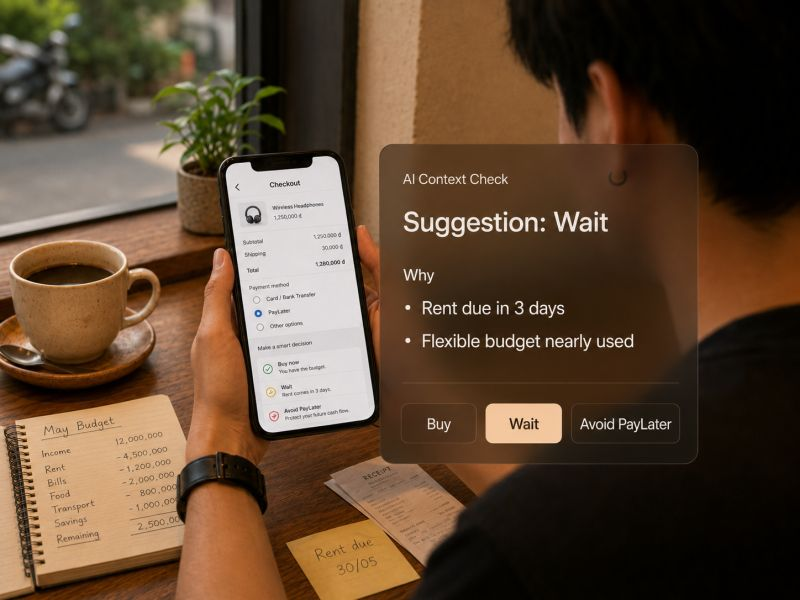
In the better pathway, purchase intent leads to an AI context check, then to a recommendation to buy, delay, reduce the amount, or avoid PayLater. The user makes a better decision, and trust increases because the product protected the relationship instead of only pushing conversion.
The important point is not that PayLater is always harmful. The point is that the moment of approval does not tell the whole story. A product can create short-term growth while also creating long-term stress, repayment friction, customer regret, support burden, and lower trust.
#Case question
Can AI PayLater define success beyond conversion?
#Working thesis
The strongest PayLater AI may not be the one that always increases approval. It may be the one users trust when it advises restraint.
A useful system may sometimes say:
Do not buy this now.
Or:
Do not use PayLater for this purchase.
That sounds counterintuitive if the product is measured only by conversion. But if the goal is long-term financial trust, restraint may be part of the value.
This is the difference between monetizing vulnerability and building financial trust infrastructure.
A conversion-first PayLater system asks:
Can this user be approved?
A trust-first PayLater system asks:
Should this user use PayLater in this moment, under this financial context, for this type of purchase?
Approval measures whether the system can say yes. Trust measures whether that yes remains good after the transaction.
This is where AI becomes more interesting. AI should not only make the product faster, smoother, or more persuasive. It may also help the system understand context: salary timing, recurring bills, spending rhythm, repayment history, cash-flow stress, purchase type, and whether the user is likely to benefit from borrowing now.
The future of PayLater may not be bigger limits or faster approval. It may be smarter restraint.
The broader lesson is that I no longer look at financial products only by asking whether they increase adoption. I start by asking what happens to the user after the product succeeds.
And in this case, the question became:
Who protects the user relationship after the product says yes?
#Pathway Lens read
The pathway is not simply checkout moment → approval → purchase. It may become:
- checkout moment → AI context check;
- payment option → recommendation;
- recommendation → user financial action;
- action → debt, budget pressure, or trust reinforcement;
- repayment outcome → long-term relationship with wallet / credit product.
The visible moment is approval or conversion. The hidden pathway is repayment, stress, regret, support, trust, and the user’s future relationship with the platform.
Pathway Lens asks what approval can become. In this case, approval can become borrowing. Borrowing can become repayment pressure. Repayment pressure can become stress, support need, regret, or trust decline. A better recommendation can become restraint, better timing, or stronger long-term trust.
#Drift / boundary / governance notes
- Drift: conversion optimization may interpret user intent as purchase readiness while missing budget pressure, rent timing, recurring bills, emotional spending, or financial fragility.
- Boundary: a payment suggestion can become credit behavior. A checkout option can become a financial decision pathway.
- Evidence: user context, affordability signal, recommendation basis, user choice, and repayment outcome should be reconstructable.
- Authority: AI should not nudge credit use without clear boundaries and user-facing explanation.
- Recovery: users need repayment support, correction paths, and safe alternatives when context was misread.
#Practical question
Can AI credit products optimize for trust and stability, not only conversion?