#When account recovery is not the same as workflow recovery
Independent Comparative Case · Evidence-First Research
12 usable public journeys · Adobe Community + Threads · Adobe official terms and appeal baseline
Research cut: 7 August 2026 · Public evidence only · Not commissioned by Adobe
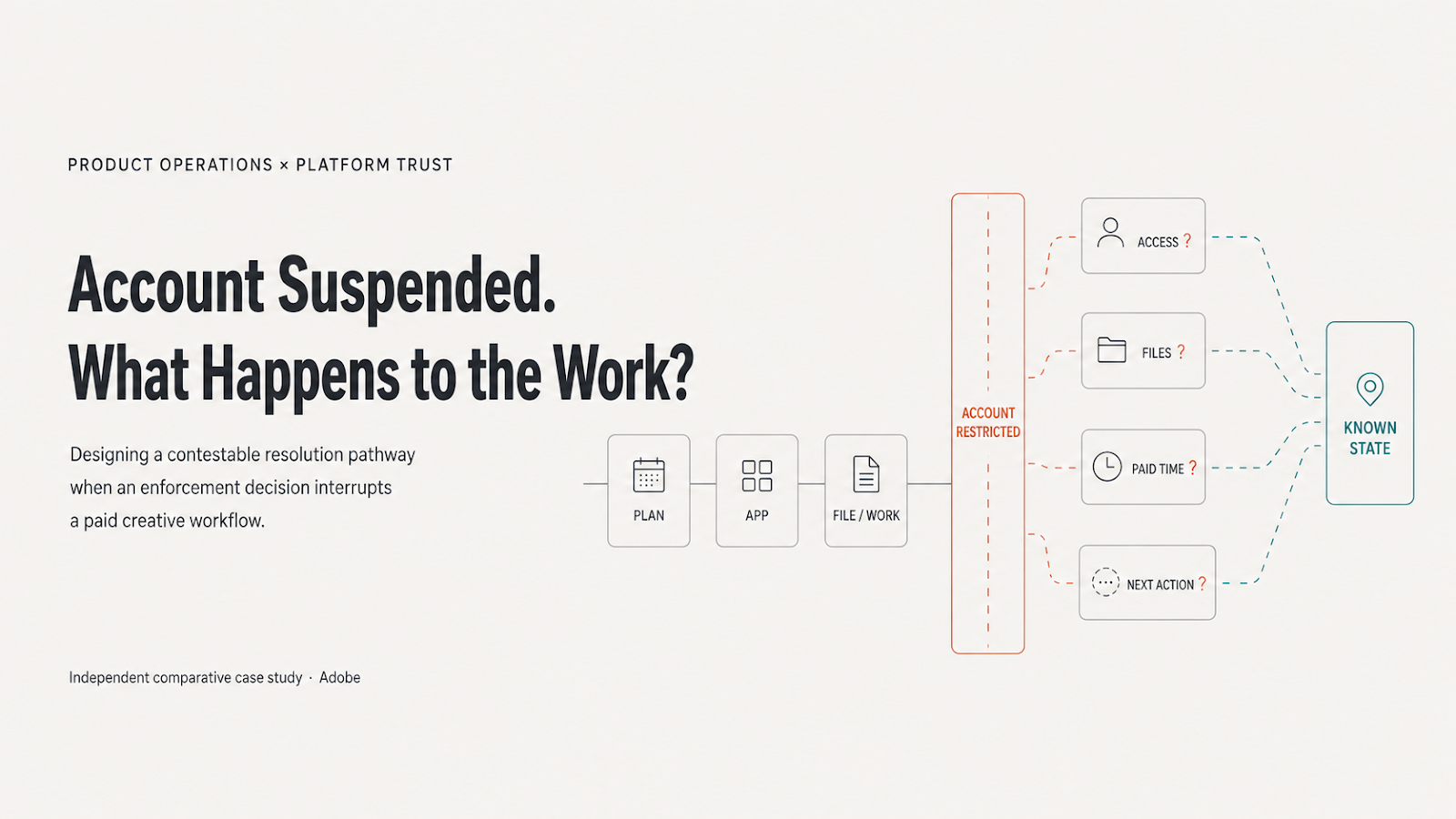
For a designer or creator, losing Creative Cloud access can interrupt more than a subscription. It can stop an edit, export, deadline, release, or client delivery. That makes account recovery and workflow recovery two related but different states.
#Executive Summary
- Question: Does the post-restriction resolution problem observed in Shopee reappear when enforcement interrupts an already-paid digital work tool?
- Evidence: 12 usable public journeys—7 Adobe Community and 5 Threads—plus current Adobe Terms and Transparency Center material. The sample is purposive and supports pathway comparison, not prevalence or error-rate estimates.
- Observed pattern: Paid or paid-as-reported access → fraud/suspicion state → restriction or cancellation → affected app/service access → support/review → divergent outcomes such as refund, restoration, extra access time, repeated escalation, replacement purchase, or reported file loss.
- Comparative finding: Shopee suggested platform decision ≠ customer problem resolved. Adobe adds access restored ≠ interrupted workflow restored.
- Product hypothesis: Where risk permits, resolution should run two tracks in parallel: decide the account case while preserving the minimum safe continuity of the customer’s current work and making recovery states visible.
This page is the portfolio summary.
The full 12-page comparative case contains the evidence matrix, Adobe official-source cards, Shopee comparison, revised Explainable Resolution Case, claim-to-source map, and research handoff.
#1. Why Adobe Is a Useful Comparative Case
Adobe removes much of the marketplace complexity in the Shopee case. A customer can pay Adobe directly, use the software inside an active workflow, and then experience enforcement that interrupts access.
That creates four distinct recovery layers:
| Layer | What can be interrupted | Resolution question |
|---|---|---|
| Account / subscription | Restricted, cancelled, inactive, or under review | What happened and can it be contested? |
| Tool / asset | Apps, paid services, or cloud assets become unavailable or unstable | What remains usable right now? |
| Customer workflow | Editing, export, creative production, or dependent work stops | How can urgent work continue safely? |
| Downstream outcome | Deadline, release, client delivery, or submission may be threatened | Can the intended outcome still be recovered? |
The public corpus includes reported deadline, professional-work, music-release/creative-production, urgent-work, replacement-purchase, and file-loss consequences. These are treated as observed only where explicitly reported.
#2. Evidence and Boundary
The case uses:
- 7 Adobe Community journeys;
- 5 researcher-supplied Threads journeys;
- 4 adjacent/context signals retained for counter-hypotheses but not counted as core journeys;
- Adobe General Terms of Use and Adobe Transparency Center appeal material as official baseline.
Eight usable journeys are graded Strong and four Medium. Grade reflects pathway completeness—not independent verification of the user’s account history or whether Adobe’s action was correct or incorrect.
- What the evidence cannot determine
- the internal fraud trigger or detection logic;
- automation versus human decision;
- false-positive status;
- prevalence or representativeness;
- whether an individual action complied with policy or law;
- whether platform steps not mentioned publicly actually occurred.
#3. Observed Public Pathway
Paid or paid-as-reported access → fraud/suspicion state → restriction/cancellation → affected app/service access → search for explanation/support → review/wait in some cases → outcome → access/payment recovery → possible workflow recovery
This is a synthesis of reported states, not an asserted universal Adobe process.
Observed outcomes include:
- refund;
- restoration;
- restoration plus extra access time;
- pending or repeated escalation;
- replacement access purchased by the customer;
- reported permanent file loss.
The important distinction is that money recovery, access recovery, file recovery, and workflow recovery do not necessarily move together.
#4. What Transfers from Shopee — and What Adobe Adds
| Dimension | Shopee | Adobe | Comparative reading |
|---|---|---|---|
| Existing customer interest | Orders, refunds, balances, benefits | Paid software/services and cloud work | Both begin after customer commitment. |
| Platform intervention | Account restriction / enforcement | Fraud-related restriction / cancellation | Enforcement need can coexist with resolution need. |
| During review | Preserve marketplace interests where appropriate | Preserve minimum safe work continuity where possible | Adobe makes time-sensitive workflow cost more visible. |
| After decision | Resolve account + affected marketplace interests | Resolve account + access/payment + interrupted work | Customer resolution extends beyond decision closure. |
| New contribution | Decision ≠ customer problem resolved | Access restored ≠ workflow restored | Workflow recovery becomes a distinct state. |
Comparative finding: the platform can interrupt a tool, the tool can interrupt a workflow, and the workflow can threaten an outcome outside the platform. The resolution object therefore cannot stop at account state or subscription entitlement.
#5. Comparative Product Hypothesis — Resolve the Case and Protect the Work
The hypothesis is not “never suspend a paid user.” Fraud and security controls may require immediate action and may make temporary access unsafe.
The design question is whether enforcement resolution and workflow continuity can be handled as two connected tracks:
| Track A — Enforcement resolution | Track B — Safe continuity / recovery |
|---|---|
| Current restriction state and safe-to-disclose reason | What apps, services, files, or functions remain usable |
| Evidence/action required from the customer | Minimum safe continuity where risk permits |
| Review stage and next update | Explicit mitigation path if continuity is impossible |
| Final account/subscription decision | Paid-time, payment, file, or access recovery where permitted |
| Remaining appeal/remedy | Interruption/recovery timeline for downstream verification |
Design question: What minimum safe continuity can remain while the enforcement decision is unresolved—and, when continuity cannot remain, what information lets the customer mitigate the workflow consequence immediately?
Read-only access, protected download/export, or temporary restricted modes are examples to investigate—not evidence-backed prescriptions. Feasibility depends on Adobe’s architecture, security risk, licensing, and content-storage design.
#6. Explainable Resolution Case — Revised for Workflow Continuity
A customer-facing resolution object would need to answer:
- Current state: restricted, under review, evidence required, decision issued, recovery in progress;
- Why am I here? safe-to-disclose reason category and what the customer can respond to;
- What is affected? plan, app, service, cloud asset, function, billing/payment, and access scope;
- What still works? what remains usable, retrievable, viewable, downloadable, or exportable;
- What can I do right now? mitigation or alternate route while review is pending;
- What do you need from me? required evidence/action and submission route;
- What is happening now? acknowledgement, review stage, and case state;
- When will I hear back? next update or resolution window without inventing a clock policy does not promise;
- What was decided? final enforcement/subscription outcome;
- What happens to paid value and my work? refund, access, compensated time, file recovery, and remaining continuity limits;
- What can I show someone else? a portable incident record of timestamps, state changes, submissions, and outcome—without claiming it proves liability.
#7. Evidence-Trail Hypothesis
Adobe also adds a secondary Explainable Trust question: can a platform-generated resolution path leave a verifiable record useful after the platform decision itself?
A credible record would require provenance, timestamps, actor/state identity, version history, evidence/submission status, and an export/share mechanism.
Boundary: such a record may establish sequence and state. It does not automatically establish causation, reasonableness, damages, or legal liability.
#What This Case Can and Cannot Conclude
Supported by the current corpus
- repeated public reports link paid or paid-as-reported Adobe access with fraud/suspicion enforcement, access interruption, support/review activity, and divergent recovery states;
- several reports explicitly describe workflow consequences;
- refund, access restoration, compensated time, file recovery, and downstream workflow recovery are analytically distinct;
- the evidence is consistent with the Shopee resolution hypothesis and adds workflow continuity/recovery as a separate resolution object.
Not supported
- prevalence or error-rate claims;
- false-positive conclusions;
- claims that subscription-fraud enforcement is automated;
- legal findings about breach, causation, damages, or liability;
- validation of minimum-safe-continuity or portable-record product concepts.
#What This Case Demonstrates
Comparative evidence research · privacy-first journey coding · cross-domain hypothesis testing · customer-resolution design · workflow continuity · enforcement/recovery separation · explainable resolution · evidence boundaries
Independent comparative work sample · Public evidence only · Research cut: 7 August 2026